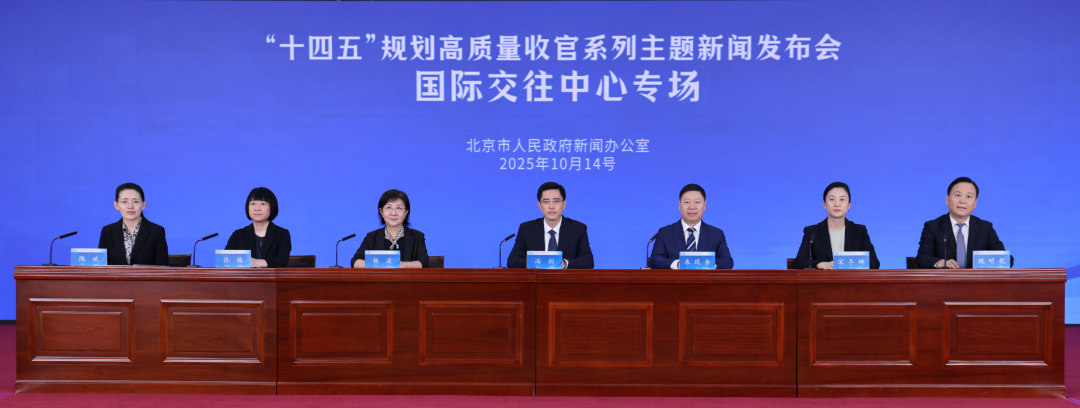
On October 14, the Information Office of Beijing Municipality held a press conference to present the high-quality achievements of the 14th Five-Year Plan period, with a specific session on Beijing’s role as the center for international exchanges. Officials from the Office of Foreign Affairs Committee of the CPC Beijing Municipal Committee and Foreign Affairs Office of the People’s Government of Beijing Municipality, the Beijing Municipal Commission of Planning and Natural Resources, the Beijing Municipal Commission of Development and Reform, the Beijing Municipal Administration of Government Services and Data Management, Chaoyang District, and Beijing North Star Company Limited provided briefings and answered questions from the press. The event was moderated by Wei Bin, Deputy Director of the International News Division of the Publicity Department of the CPC Beijing Municipal Committee.
Yang Jun, Deputy Director-General of Beijing Municipal Commission of Planning and Natural Resources:
Improving Beijing’s role as the center for international exchanges is a key task for implementing the capital’s strategic role and strengthening its position as the “four centers”. During the 14th Five-Year Plan period, Beijing has thoroughly implemented the Master Plan of Development for Beijing (2016-2035) and has successively prepared the Special Plan for Improving Beijing’s Role as the Center for International Exchanges and the Plan of Beijing for ImprovingIts Role as the Center for International Exchanges during the 14th Five-Year Plan Period. These plans clearly define the strategic tasks, functional systems, and spatial layout, and outlines a development blueprint for strengthening Beijing’s role as the center for international exchanges. On this basis, in March 2025, we issued and implemented the Implementation Guidelines for the Plan on Building Beijing into the Center for International Exchanges, further providing solid planning support for the development and construction of key international exchange areas and facilities. I will now introduce the relevant work from two aspects.
1. Issuing and Implementing the Special Plan: Creating Highlighted Areas and Facilities for International Exchanges Guided by the “One Core, Two Axes, Multiple Areas” Spatial Layout
The core area of the capital, centered around Tian’anmen Square, the Forbidden City, and other traditional sites for state affairs, has focused on enhancing the overall environment of key districts. Efforts have been made to revitalize and repurpose facilities such as Qingcheng Palace and the Divine Music Administration, to provide more venues and settings for international exchanges that reflect both traditional Chinese culture and the spirit of the new era.
The international exchange capacity of Beijing’s Central Axis and its extensions, as well as Chang’an Avenue and its extensions, has been significantly enhanced, contributing to cultural exchanges and mutual understanding between China and the rest of the world. In July 2024, the Beijing Central Axis was inscribed on the UNESCO World Heritage List, showcasing to the world Beijing’s unique grand spatial order, its highly rhythmic urban layout, and the aesthetic value of Eastern architecture. China National Convention Center (CNCC) Phase II was completed in the northern section of the Central Axis, successfully hosting major diplomatic and international events such as the Fourth Ministerial Meeting of the China-CELAC Forum and the Global Women’s Summit. In the southern section, the Nanyuan Forest Wetland Park was opened to the public, creating a new spatial pattern along the Central Axis featuring “Olympic Forest in the north, Nanyuan Forest in the south.” The overall planning scheme for the first phase of the Dahongmen museum cluster has been formulated, and the construction of the major country cultural reception hall is progressing rapidly. At the western end of Chang’an Avenue, the Shougang Park, where major events such as the Winter Olympics and the China International Fair for Trade in Services (CIFTIS) were held, has become an important hub for international exchanges. Driven by Beijing CBD, the city’s international exchange functions have extended from Chaoyang District further east toward the Beijing Municipal Administrative Center (BMC).
In the eastern part of the city, land allocation procedures for diplomatic use in the fourth embassy zone have been completed, and the surrounding transportation system has been further improved. The 18-kilometer waterfront greenway of Liangma River International Waterfront has been fully completed, becoming a vibrant new landmark for cultural exchanges and people-to-people interaction between China and other countries. The three cultural landmarks in the BMC have been completed and put into operation, hosting events such as “Love in the Sunshine” Summer Camp for Children from China and Africa. Capital International Exhibition & Convention Center (CIECC), or New China International Exhibition Center Phase II, has commenced operation, demonstrating Beijing’s efforts to further open up its modern service industries.
In the northern area, Beijing Yanqi Lake International Conference Resort has made steady progress in its capacity expansion and upgrading. Building on its successful hosting of the APEC Summit and two sessions of the Belt and Road Forum for International Cooperation (BRF), it has also provided comprehensive services for the Beijing Winter Olympics and Paralympics. By the end of 2024, the venue had hosted 25,000 events, including the G20 Meetings of Energy Ministers, and the World University Presidents Forum, with its international influence continuing to grow. The renovation and upgrade of the China Great Wall Museum is expected to complete its main construction by the end of the year. The site will serve as a model base for the protection and inheritance of the Great Wall World Cultural Heritage and as the permanent venue for the Badaling Summit Forum.
In the western area, the ZGC International Innovation Center, now the permanent venue of the ZGC Forum, has developed into a world-class platform for cutting-edge international exchanges in science and technology, integrating functions such as technology forums, exhibitions, technology transactions, and achievement releases. The interior decoration is under progress in the northern area of the Palace Museum; once completed, it will promote the preservation and adaptive reuse of cultural heritage while providing exhibition spaces with distinct characteristics of the Palace Museum.
In the southern area, Beijing Daxing International Airport has been in operation for six years, connecting nearly 30 countries and regions worldwide and becoming deeply integrated into the “Air Silk Road.” Its role as an international hub for passenger and cargo transportation has been further strengthened, with enhanced aviation resource allocation. Construction and planning in Beijing Daxing International Airport Economic Demonstration Zone are moving forward rapidly. The comprehensive bonded zone spanning Beijing and Hebei Province has received regulatory approval and is already operating under sealed customs control, while the integrated implementation plan for the convention and exhibition district has also been approved.
2.Following Implementation Guidelines to Strengthen Layered Spatial Support for International Exchange Functions
To further align the functional system of Beijing’s role as the center for international exchanges with spatial layout plan, the Implementation Guidelines refine and allocate the tasks for improving Beijing’s role as the center for international exchanges across all districts, towns, and subdistricts. Each district is encouraged to leverage its unique resources and integrate the development of international exchange functions with its own positioning and planning objectives. By harnessing the combined strengths of districts and townships, Beijing aims to continuously enhance its capacity for international exchange services and promote high-level opening up and development.
Firstly, theImplementation Guidelines take blocksunder planning as the basic units to strategically coordinate the spatial layout of Beijing’s role as the center for international exchanges. For the first time, 289 key blocks and 14 key towns have been identified as focal areas to enhance guarantees for spatial capacity, transportation systems, and other supporting elements. Taking the regulatory plan for the Jinzhan International Cooperation Service Zone as an example, and in combination with the development of the fourth embassy zone, it is planned to create a cluster for international organizations, enhance supporting resources such as international education and healthcare, and foster a new international exchange scene envisioned as “another Sanlitun in Beijing.” Secondly, the guidelines flesh out the direction for the construction of international exchange facilities. Relying on major conference and exhibition venues, cultural sites, scenic attractions, and commercial spaces, Beijing strengthens its service support capabilities for both daily operations and major events. Through establishing a coordinated advancement mechanism for key facilities, the city ensures that the design, construction, and operation of these sites fully incorporate diplomatic and foreign affairs needs, so as to cultivate more high-quality, distinctive spaces for diplomatic activities.
Currently, projects in the pilot area of Shougang Park, Garden Expo Park, and Yongding River are progressing smoothly. The urban design plan for the Bio-Park located in southern Beijing, envisions a hub that connects global innovation resources in the field of pharmaceuticals. The international competition results for the core area of the Liulihe Relic Site Park have been announced, and comprehensive optimization of the selected design is underway. This marks a key step toward advancing a major cultural project that provides concrete evidence of Beijing’s 3,000-year history. In the next step, Beijing will continue to take blocks under planning as the basic unit to systematically plan and promote the construction of additional landmark projects and facilities that highlight the city’s international exchange functions.
During the 14th Five-Year Plan period, Beijing has made comprehensive progress in strengthening key facilities and capabilities for international exchange, and steadily improved its capacity and service standards for major diplomatic and foreign affairs events. In the 15th Five-Year Plan period, the city will continue to act on the plans, further refine the “one core, two axes, multiple areas” spatial layout for international exchanges, and enhance its cultural appeal, global style, and Chinese identity. Beijing aims to create diverse international exchange settings and make new contributions to supporting the country’s overall diplomacy and the capital’s high-quality development.