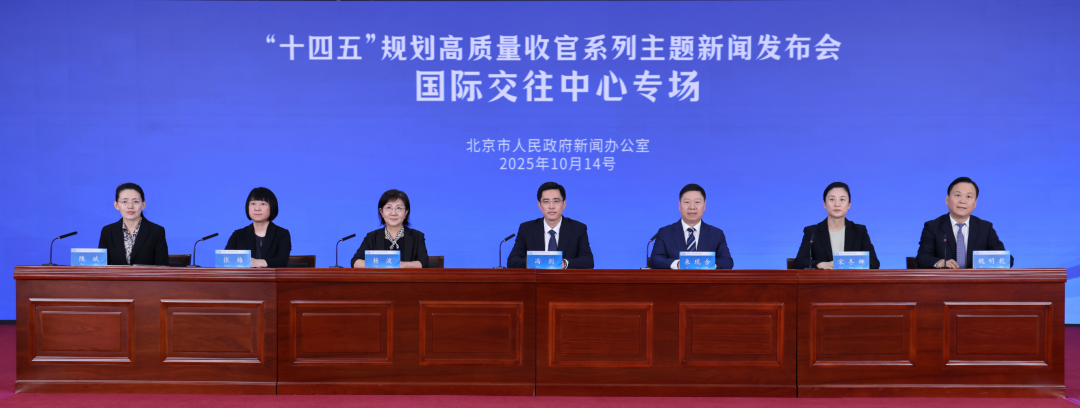
On October 14, the Information Office of Beijing Municipality held a press conference to showcase the high-quality achievements of the 14th Five-Year Plan period, with a dedicated session on the development of Beijing as the center for international exchanges. Officials from both the Office of Foreign Affairs Committee of the CPC Beijing Municipal Committee and Foreign Affairs Office of the People’s Government of Beijing Municipality, the Beijing Municipal Commission of Planning and Natural Resources, the Beijing Municipal Commission of Development and Reform, the Beijing Municipal Administration of Government Services and Data Management, Chaoyang District, and Beijing North Star Company Limited provided briefings and took questions from the press. The event was moderated by Wei Bin, Deputy Director of the International News Division of the Publicity Department of the CPC Beijing Municipal Committee.
Song Dongna, Deputy Director General of the Beijing Municipal Administration of Government Services and Data Management
As the center for international exchanges, Beijing has warmly welcomed visitors from around the world in recent years. In response to the diverse needs of foreign nationals in Beijing—whether for business, work, study, travel, or daily life—relevant departments have been working together to advance reforms that enhance service accessibility for foreigners and improve the city’s international services. We hope all our guests can truly feel the thoughtfulness and warmth encapsulated in “Beijing Service”.
First, Beijing has been enhancing its point-of-arrival services to ensure smooth entry and easy travel. We have implemented various visa policies, including visa-free entry, 240-hour visa-free transit, and port visas, to further facilitate international visits to Beijing. “Beijing Service” counters have been established at both Beijing Capital International Airport and Beijing Daxing International Airport to provide one-stop services for international visitors, covering various sectorslike finance, communication, transportation, and tourism. Centering on the essential needs for those new to the city, Beijing has released guides such as the Welcome to Beijing: Essential Tips for New Arrivals and the Guidance on Entry and Residence Services for Foreigners, to help expatriates quickly adapt to local life.
Second, Beijing has been removing service barriers to ensure a smooth, worry-free experience for foreigners in the city. Beijing is the first city in China to allow foreign nationals to handle services like social and medical insurance, housing providentfund, banking, and telecommunications services online using only their passports. Foreigners can also apply for SIM cards online and collecting them offline. The city has improved payment across key sectors, including dining, accommodation, transportation, sightseeing, shopping, entertainment, healthcare, and education. To make payments more convenient for international visitors, Beijing has introduced the BEIJING PASS, a multifunctional card, along with two products that integrate communication and payment services—Travel Pass and CUBe Card. Beijing has also released the first English map in China, “Beijing Map”, and enabled the use of international bank cards such as Visa card and Mastercard for tap-and-go metro access, ensuring a smoother travel experience for foreign passengers. Additionally, we have enhanced international medical services by publishing an English-language guide for foreigners seeking medical care in Beijing and launching an English version of the 114 medical appointment platform to make healthcare more accessible for foreign nationals in Beijing.
Third, we have been rolling out distinctive service initiatives to deliver an upgraded experience for international visitors in Beijing. To improve the inbound tourism experience, we have introduced a variety of specialized travel products such as World Heritage tours, traditional hutong tours, and Central Axis cycling routes, alongside thematic routes such as “Beijing New Discoveries” and “City Walks”. We have also published the HelloBeijing. Meanwhile, Beijing has become the first city in China to launch one-stop service centers that process tax refund applications citywide. This integrates instant tax refunds into bank branch services, raises the refund limit, and provides more flexible refund channels. To encourage foreign investment and business development, Beijing has released China’s first bilingualGuide for Registering a Foreign-Invested Company and an accompanying FAQ handbook. Additionally, the city has launched the bilingual (Chinese–English) “E-Window” enterprise service platform, enabling fully online registration for foreign-invested companies. To promote the employment of foreign professionals in Beijing, the city has expanded and upgraded the catalog of recognized international professional qualifications and integrated the Foreigner’s Work Permit with the Social Security Card. We are also enhancing the “Study in Beijing” brand through the “Study in Beijing+” initiative, which establishes a one-stop service platform for international students, aiming to foster their education, innovation, and entrepreneurship.
Fourth, we have been improving the foreign-related service system to make it more precise and efficient. Beijing has been enhancing its information services by launching an online service system centered on the international version of its official website, which is available in nine languages. The website integrates information release, public services, and interactive consultations, and provides over 500 consolidated policies and over 300 user-friendly service guides. We have also introduced innovative tools such as “HowBeijing” video guides, covering real-life scenarios that foreign residents often encounter in the city. The English-language WeChat official account “BeijingService” and the English mini-program on “Jingtong” offer foreigners information and services for adapting to local life. To enhance the international level of government services, we have included the procedures for “Qualified Foreign Investor (QFI) Qualification and Account Opening” and “Working in China for Foreigners” in the mechanism for “All-in-One-Go” government services in 2025, improving user experience. Government service centers at all levels, along with one-stop international talent service centers, are equipped with foreign-language staff and smart devices to provide multilingual business consultations and service handling. Beijing has also developed an internationalized city hotline—12345, which can receive calls in eight foreign languages. The international version of the city’s website features a dedicated “12345online” section. The Beijing Service WeChat official account features a message board where foreign residents can submit their requests. To help them better understand relevant policies and services, we have built multiple communication platforms, such as the Beijing Forum on Swift Response to Public Complaints, Citizen Hotline Open Days, and the documentary film Hotline Beijing. In addition, for two consecutive years, we have conducted surveys on Beijing’s international service environment, listening to the needs and voices of foreigners living in or planning to come to the city, and continuously refine and tailor our service initiatives based on the feedback.
During the 15th Five-Year Plan period, we will continue to build up our capabilities to deliver higher-quality and more convenient international services in the city.