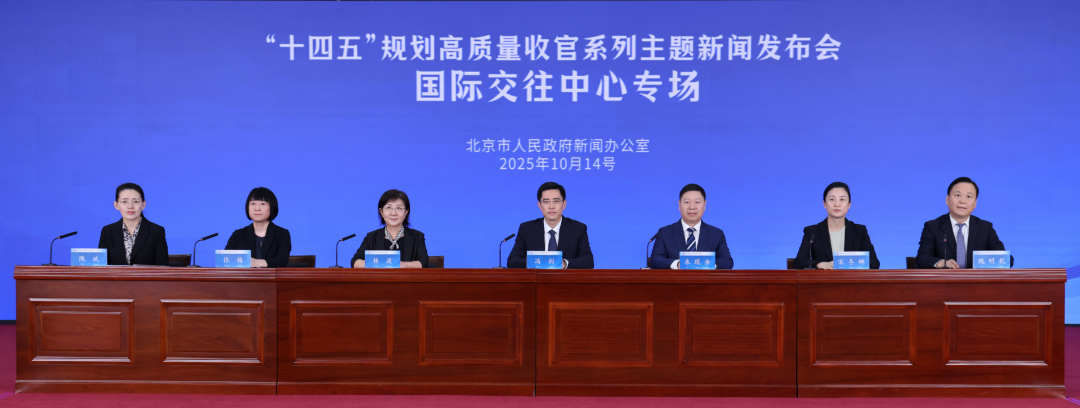
On October 14, the Information Office of Beijing Municipality held a press conference to present the high-quality achievements of the 14th Five-Year Plan period, with a specific session on the development of Beijing’s role as the center for international exchanges. Officials from the Office of Foreign Affairs Committee of the CPC Beijing Municipal Committee and Foreign Affairs Office of the People’s Government of Beijing Municipality, the Beijing Municipal Commission of Planning and Natural Resources, the Beijing Municipal Commission of Development and Reform, the Beijing Municipal Administration of Government Services and Data Management, Chaoyang District, and Beijing North Star Company Limited provided briefings and answered questions from the press. The event was moderated by Wei Bin, Deputy Director of the International News Division of the Publicity Department of the CPC Beijing Municipal Committee.
Feng Jian, Deputy Director General of the Office of Foreign Affairs Committee of the CPC Beijing Municipal Committee and Foreign Affairs Office of the People’s Government of Beijing Municipality, Spokesperson:
Strengthening Beijing’s role as the center for international exchanges is a glorious mission entrusted to the city by the CPC Central Committee with Comrade Xi Jinping at its core. It is both a strategic choice to open a new chapter in major-country diplomacy with Chinese characteristics in the new era, and an inherent requirement for Beijing to bolster its position as the “four centers” and deliver the “four services”. During the 14th Five-Year Plan period, under the strong leadership of the CPC Central Committee with Comrade Xi Jinping at its core, Beijing followed Xi Jinping Thought on Socialism with Chinese Characteristics for a New Era, particularly Xi Jinping Thought on Diplomacy, and implemented General Secretary Xi’s important instructions on Beijing’s development. The city resolutely fulfilled its responsibilities as the capital of a major country, providing quality services and support for 15 major diplomatic and state events, receiving nearly 20,000 state and foreign dignitaries. The city planned and implemented 78 facility projects, attracted over 8,000 new foreign-invested enterprises, set up more than 100 international schools, and launched 18 pilot international medical institutions. These measures have significantly enhanced Beijing’s international environment, continuously boosting the capital’s global influence, attractiveness, and reputation. According to the International Exchange Centers Index 2025released last month, Beijing ranks sixth globally, securing its position as the top-ranked city in China for three consecutive years. Next, I will give an overview of Beijing’s main achievements in improving its role as the center for international exchanges during the 14th Five-Year Plan period across five key areas.
First, Beijing’s capacity to provide services and support for head-of-state diplomacy has reached a new level. Beijing is not only the core hub for China’s major-country diplomacy with Chinese characteristics, but also the primary stage for head-of-state diplomacy. We have always regarded serving the major diplomatic agenda of General Secretary Xi Jinping as the foremost political task in advancing Beijing’s role as a center for international exchanges. Beijing took the lead in establishing the nation’s first comprehensive system to support head-of-state diplomacy, continuously improving the long-term service and support system for major state events. Guided by the principle of serving both routine and major events, the city has steadily enhanced capabilities in conference services, protocol reception, city operations, environmental management, and volunteer services, further polishing the golden brand of “Beijing Service”. Beijing has successfully provided high-quality services for major state events such as the Beijing 2022 Winter Olympics, the Belt and Road Forum for International Cooperation (BRF), and the Beijing Summit of the Forum on China-Africa Cooperation (FOCAC), earning high praise from both domestic and international participants. Moreover, the capital has deeply leveraged its cultural heritage and technological innovation achievements to build a “Visit Beijing” diplomatic reception resource system encompassing 456 designated sites. This system offers foreign guests a panoramic and multifaceted view of the capital’s achievements in the new era.
Second, Beijing has made new strides in its capacity to host international exchanges. During the 14th Five-Year Plan period, Beijing continued to optimize its spatial layout for international exchanges featuring “one core, two axes, and multiple areas” and accelerated the construction of key facilities, comprehensively enhancing its overall capacity to host international activities. TheImplementation Guidelines for the Plan on Building Beijing into the Center for International Exchanges was issued, designating 289 key blocks, 14 key townships, 66 priority facilities for optimization, and 15 new facilities for construction, thereby extending the city’s international exchange functions to the community level. Targeted improvement projects advanced steadily in traditional state event areas such as Tian’anmen Area and the surroundings of Zhongnanhai, while the international exchange functions along Chang’an Avenue and its extensions were further enhanced. In support of the inscription of Beijing Central Axis as a World Heritage site, Beijing continued to enhance the international exchange functions of the Central Axis and its extensions, with historic and cultural landmarks such as the Temple of Heaven, Zhengyangmen, and Altar of the God of Agriculture achieving notable results in hosting diplomatic events. Comprehensive upgrades of the first, second, and third embassy areas, as well as the planning and construction of the fourth embassy area made solid progress. Major facility projects were advanced to high standards. The Beijing Yanqi Lake International Conference Resort has been expanded and upgraded, with Yanbai Villa, Qihu Hotel, and Journalists’ Home Hotel completed and put into operation. The Zhongguancun International Innovation Center, the China National Convention Center Phase II, and the Capital International Exhibition & Convention Center have all opened for use, nearly doubling the city’s total indoor exhibition area compared with the 13th Five-Year Plan period. Meanwhile, three cultural landmarks (a theatre, a library, and a museum) in the Beijing Municipal Administrative Center (BMC) have continued to strengthen their capacity to host diplomatic events, presenting a rich variety of international cultural activities. Beijing’s two airports have continued to enhance their international competitiveness, further strengthening the city’s role as a leading gateway to the world.
Third, Beijing has made progress in advancing high-standard opening up. The economic potential embedded in Beijing’s role as the center for international exchanges has been unleashed at a faster pace. Vigorous efforts have been made to build platforms, smooth channels, and pool resources to transform the city’s advantages in global connectivity into tangible drivers of high-quality development. Beijing is actively developing national-level platforms for opening up and continuously enhancing the international profile of the China International Fair for Trade in Services (CIFTIS), the ZGC Forum, the Financial Street Forum, and the Beijing Culture Forum. President Xi Jinping has delivered four video addresses and sent seven congratulatory letters to these events, drawing strong attention both at home and abroad. Country-specific opening-up initiatives have continued to advance. The Beijing Sino-German International Cooperation Industrial Park and the China-Japan Innovation & Cooperation Demonstration Zone have seen strong growth, together attracting 286 foreign-funded and related enterprises. Deeply integrated into global innovation networks, Beijing has achieved fruitful outcomes through international scientific and industrial exchange events such as the Global Digital Economy Conference, the International Congress of Basic Science, and the World Robot Conference. International travel to and from Beijing has recovered rapidly due to China’s new entry and exit policies. In 2024, Beijing’s two airports served over 120 international and regional destinations, and the city’s ports processed 4.85 million inbound and outbound trips by foreign nationals, representing a 125% year-on-year increase. Notably, inbound trips reached 3.21 million, an increase of 188% year-on-year. Beijing has introduced a series of measures to facilitate the establishment of international organizations in the city, attracting international and multilateral institutions such as the Global Alliance for Trade in Services (GATIS) and the World Internet Conference (WIC). The city has also established China’s first cluster of headquarters of international science and technology organizations. As a result, the number of international organizations in Beijing has risen to 127, marking a 32% increase since the end of the 13th Five-Year Plan period. Beijing has also curated flagship international events such as the “Beijing Night” and the Reception of China Development Forum, and hosts over 300 major diplomatic activities each year. A series of landmark and pioneering foreign-invested projects, including the AstraZeneca’s Global Strategic R&D Center and Deloitte University, have been successfully implemented. The city is now home to 271 regional headquarters of multinational companies and 279 foreign-invested R&D headquarters, with the total number of foreign-invested enterprises exceeding 35,000. The city is home to 47 Fortune Global 500 companies, the highest number of any city worldwide for 13 consecutive years.
Fourth, Beijing has reached new milestones in expanding its international “circle of friends.” The city has actively consolidated longstanding partnerships while forging new ones, contributing its strength to building a global network of partners. It has continuously expanded channels and improved the quality and effectiveness of international engagement. The number of international sister (friendship) cities at the municipal and district levels has reached 287, forming a global “circle of friends.” In recognition of these efforts, Beijing was awarded the 2024 “International Friendship City Award for Outstanding Contribution”. During the COVID-19 pandemic, Beijing stood in solidarity with its partners, donating supplies to 55 cities and regions across 27 countries and collaborating on pandemic prevention with 83 cities in 44 countries, jointly strengthening global defenses. The well-designed signature programs such as “Beijing Day” and “Beijing Week” serve as a “bridge of hearts”, strengthening exchanges and mutual learning and forging closer bonds between peoples through diverse cultural activities. The city also supported a wide range of entities, including people’s organizations, social groups, universities, enterprises, media, and think tanks, in engaging in people-to-people international exchanges, further deepening public support for friendship between China and other countries. By maintaining close engagement with international organizations such as United Cities and Local Governments (UCLG), U20, and ICLEI—Local Governments for Sustainability, and participating in agenda-setting and standards development, Beijing contributed to reforms of the global governance system, enhancing its influence and capacity to shape. Nearly 700 national industry associations and chambers of commerce based in Beijing were encouraged to engage in international exchanges. Local social organizations actively participated in multilateral events such as sessions of the UN Human Rights Council, the UN Climate Change Conference, the BRICS Civil Society Organizations Forum, and the Civil Society 20 (C20). As a result, 26 organizations in Beijing have obtained consultative status with the UN Economic and Social Council (ECOSOC).
Fifth, Beijing’s international environment has reached a new level.The center for international exchanges serves as a vital platform for advancing the building of a community with a shared future for humanity. Facilitating personnel exchanges, flow of production factors, and exchanges among civilizations is an inherent task. In recent years, Beijing has actively improved its international environment and further opened up to attract talent and investment, positioning itself as an attractive capital that “appeals to people from near and far”. The city introduced the Beijing Internationalization Service Work Plan and became the first provincial-level jurisdiction in China to implement payment facilitation measures. It also compiled guides such as the Welcome to Beijing: Essential Tips for New Arrivals, the Guidance on Entry and Residence Services for Foreigners, and the Guide for Foreigners Touring Beijing. “Beijing Service” airport service points have been established, offering more than 20 high-frequency services. BEIJING PASS has been launched, enabling seamless access to transportation, scenic attractions, and retail shopping with a single card. In addition, tap-and-go subway access with five major international bank cards and the integration of bank cards with SIM cards have effectively addressed bottlenecks in payment, transportation, and communication services. Beijing has been promoting full coverage of the “Joint Application of Two Permits” for foreign professionals and expanding the use of foreign permanent resident ID cards in over 20 areas. It took the lead in China to achieve fully online procedures for establishing foreign-invested enterprises and issued a catalog of recognized international professional qualifications, which allows, for the first time, mutual recognition of professional qualifications between China and other countries. The Regulations of Beijing Municipality on Improving Language Environment for International Exchanges was launched, along with an international version of the city’s official portal website and an English-language WeChat official account. The city also developed a Beijing English Map, and the accuracy of foreign-language signs in public spaces across the city exceeds 99%. These coordinated policies have made it increasingly convenient for foreign nationals to do business, study, and travel in Beijing.
Looking back on the achievements made during the 14th Five-Year Plan period, the most fundamental factor lies in the leadership and guidance of General Secretary Xi Jinping and the scientific guidance of Xi Jinping Thought on Socialism with Chinese Characteristics for a New Era, especially Xi Jinping Thought on Diplomacy. These accomplishments have also been made possible through the support and guidance of the central authorities, the strong leadership of the CPC Beijing Municipal Committee and Beijing Municipal Government, and the concerted efforts of all citizens and sectors across the city. Looking ahead to the 15th Five-Year Plan period, we will uphold Beijing’s strategic positioning as the capital, continue to strengthen its role as the national center for international exchanges, and take a more proactive approach in serving the overall diplomatic endeavors of the Party and the country as well as the capital’s development in the new era. Through these efforts, we will make more contributions to advancing Chinese modernization.
Question from the Press
Reporter:We have just heard an overview of Beijing’s main achievements in improving its role as the center for international exchanges over the past five years. What will be the main priorities for further advancing this effort in the next stage, particularly during the 15th Five-Year Plan period?
Feng Jian, Deputy Director General of the Office of Foreign Affairs Committee of the CPC Beijing Municipal Committee and Foreign Affairs Office of the People’s Government of Beijing Municipality, Spokesperson:
The 15th Five-Year Plan period marks a crucial stage in strengthening Beijing’s role as the center for international exchanges. We will focus on the overarching goal of developing Beijing into a globally influential center for international exchanges with Chinese characteristics. Two main priorities are serving the country’s overall diplomatic agenda and supporting the capital’s high-quality development. We will enhance supporting facilities and service capacity to continuously optimize the overall service system of Beijing as the center for international exchanges. The ultimate aim is for Beijing to lead the country in putting into practice the vision of a community with a shared future for humanity and serving the country’s international exchange events. In doing so, we will make greater contributions to the capital’s development in the new era. Our work will focus on five key areas.
First, serving the country’s international exchange initiatives. We will strengthen venue and space support, enhance service capacity, and leverage technologies to provide comprehensive, high-standard support for high-level diplomatic and foreign-related activities, so as to better meet the international exchange needs of the CPC Central Committee, the State Council and the Central Military Commission.
Second, supporting the capital’s high-quality development. By closely following global economic trends, we will focus on strategic emerging and future-oriented industries, promote the mutual reinforcement between high-level “bringing in” and high-quality “going out” initiatives, and attract high-end resources such as multinational enterprises, international organizations, and global exhibitions. The goal is to make full use of national-level platforms for opening up and further enhance Beijing’s capacity for coordinated allocation of international resources.
Third, prioritizing a people-centered approach. We will upgrade facilities and services at the city’s two airports, further develop a convenient foreign-related service system, and foster a favorable international environment for living, working, tourism, and education. This will allow both domestic and international residents to share in the benefits of Beijing’s international development and enhance the sense of gain and happiness of citizens and international visitors.
Fourth, showcasing Beijing’s international appeal as the capital of a major country. We will draw on Beijing’s rich historical and cultural heritage, highlight cutting-edge scientific and technological achievements, and promote its image through sister-city partnerships and social organizations. By telling genuine and engaging stories of China, we aim to comprehensively enhance Beijing’s charm, international attractiveness, and global influence.
Fifth, balancing development and security. We will pursue a holistic approach to national security, adhere to bottom-line and worst-case scenario thinking, and proactively address the instability and uncertainty of the complex external environment. Security and development will be integrated into all stages and aspects of improving Beijing’s role as the center for international exchanges, creating a sound external environment for the capital’s high-quality development.