Editor’s Note
Elegantly dressed in formal attire, there’s a group of people, who always actively engage in important diplomatic and foreign affairs events. Despite their busy schedule, they take time to explore the vibrant streets and alleys of Beijing, immersing themselves in the history and cultural allure of this modern metropolis. Who are they? They are ambassadors representing over 170 countries across Asia, Europe, Africa, North America, South America and Oceania, in China.
Curious about their impressions of Beijing? Which popular tourist attractions have they visited, and what cuisines do they like? Do they prefer unwinding at a cafe in Sanlitun, cycling along the riverbanks, or taking leisurely strolls after work? Moreover, what messages do they wish to convey to the people of Beijing?
To answer those questions, Beijing Municipal Foreign Affairs Office has partnered with Beijing Daily and BRTV to create the “Beijing in the Eyes of Ambassadors” series. In this episode, we take you to the Capital Museum, where Carlos Vasquez, Peruvian Ambassador to China, shares his Beijing story in front of the exhibition “Maize·Gold·Jaguar: A Grand Exhibition of Ancient Maya and Andean Civilizations”.
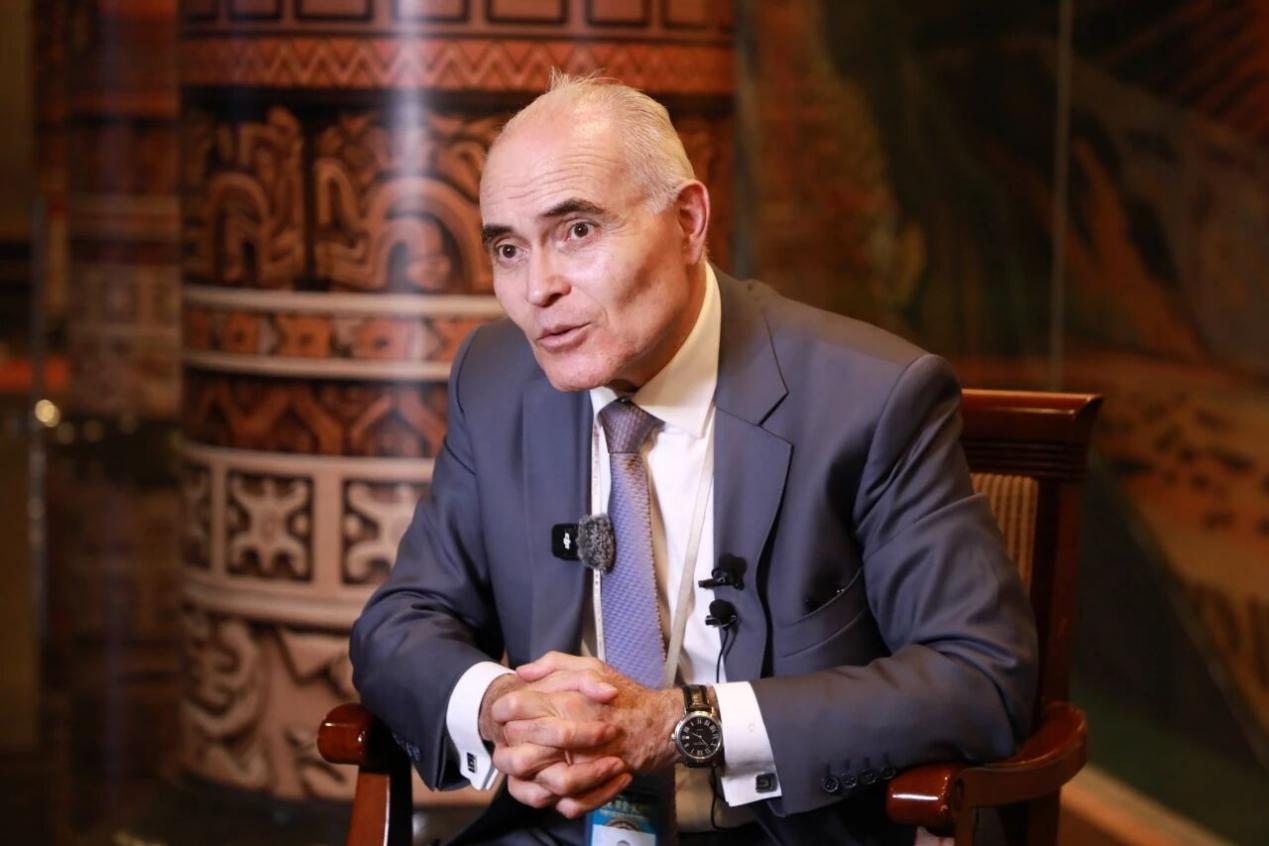
The exhibition “Maize·Gold·Jaguar: A Grand Exhibition of Ancient Maya and Andean Civilizations” is now on display at the Capital Museum. As visitors step into the hall housing the exhibition of ancient Peruvian civilization, they are immediately captivated by the cultural treasures that have traveled across the ocean.
Brilliant cultures from distant lands shine side by side. The profound ties between Chinese and Peruvian civilizations have also given Carlos Vasquez, Peruvian Ambassador to China, a strong sense of affinity with Beijing, an ancient capital with a history spanning millennia. In his view, China stands as a model of the harmonious integration of tradition and modernity. Beijing’s rich historical and cultural heritage as well as modern dynamism provides the city with renewed confidence in pursuing high-quality development.
Beijing Is a Magnificent City with a Long History
Beijing has a history spanning over 3,000 years, including more than 870 years as the national capital. “Beijing is a magnificent city with a long history, and I enjoy visiting its various cultural relics and historic sites,” said Vasquez. From the Palace Museum and the Temple of Heaven to the Great Wall and the Lama Temple, Beijing’s classical charm often reminds him of Cusco, the capital of the Inca Empire, and Lima, the capital of Peru. “Peru is also considered one of the cradles of human civilization. This is something our two countries have in common,” he said.
Vasquez also loves Beijing’s vibrant everyday life. He has lost count of how many times he has enjoyed the famous Beijing Roast Duck. For him, having tea at a teahouse is a highly meaningful cultural ritual. He can also reel off many experiences beloved by Beijingers, from viewing cherry blossoms at Yuyuantan Park to taking cruises on the Liangma River. He is deeply impressed with Beijing’s urban governance. “The city is clean, tidy and beautiful. I am truly enjoying my life in Beijing,” he said.
When discussing urban renewal, Vasquez spoke highly of the 798 Art District. Once an industrial area, it has now been transformed into a well-known cultural and artistic space. Vasquez said that visiting galleries and enjoying coffee in the 798 Art District is one of his favorite ways to relax. “I have visited many beautiful galleries. This approach to urban renewal is very clever,” he said.
Exploring More Possibilities for Cooperation
In 1983, Beijing and Lima, the capital of Peru, established sister-city relationship, making Lima Beijing’s first sister city in Latin America. Over more than four decades, the two cities have deepened mutually beneficial cooperation in areas such as culture and education. Through subnational exchanges between China and Peru, they have jointly written a story of friendship that transcends mountains and seas.
The Port of Chancay, which opened in November 2024, is a landmark project under China-Peru Belt and Road cooperation, as well as an important logistics hub connecting the Asia-Pacific region and Latin America. Through the Port of Chancay, high-quality Peruvian agricultural products such as blueberries and avocados can be shipped directly to China. Not long ago, Vasquez attended a container-unsealing ceremony for the first shipment of Peruvian blueberries from the new production season to arrive in North China. The “blue gems” from the Peruvian highlands have begun entering the Beijing-Tianjin-Hebei and North China markets in large quantities. Peru has now become an important fruit supplier to China.
Vasquez has high expectations for deeper industrial cooperation. He said Peru has signed a number of science and technology cooperation agreements with China, especially in artificial intelligence, hoping to further promote the development of smart cities in Peru and support local industries. Speaking of electric vehicles, Vasquez said he sees great potential for cooperation between the two sides and looks forward to introducing Chinese electric buses to Peru. He acknowledged that Peru’s charging network is not yet fully developed, and expressed the hope that public transportation could serve as a starting point for gradually advancing in-depth cooperation in the new energy sector.
As a national hub for sci-tech innovation, Beijing has notable strengths in high-tech industries such as artificial intelligence. Vasquez said, “There is strong potential for developing these emerging industries in Peru. We welcome Beijing’s sci-tech innovation and manufacturing enterprises to visit Peru and explore opportunities for business development.”
Click the video for Ambassador Vasquez’s impressions of Beijing.
Committed to Promoting Cultural Exchanges and Fostering People-to-People Connectivity
Not long ago, Vasquez watched the film Dear You in Beijing. He found the heartwarming story, which portrays overseas Chinese working hard to build better lives, remaining deeply attached to their homeland, and keeping their promises, “very touching”.
In recent years, an increasing number of Beijing’s literary and artistic productions have reached audiences in Peru. Outstanding films and TV dramas such as Ride On and The Tale of Rose have been screened or broadcast there. “Many Chinese films and TV dramas are very popular in Peru,” Vasquez said. He plans to propose to relevant Peruvian authorities that Dear You be introduced to Peru and other Latin American countries for screening. Vasquez noted that Peruvian films have also been screened in Beijing with the support of relevant institutions. He hopes that in the future, mainstream platforms can help more Beijing audiences learn about Peru’s customs and culture through film.
Vasquez noted that Peru is home to a large Chinese community, and Chinese-influenced ways of life have been integrated into local Peruvian culture. This is particularly evident in its food culture: Chinese restaurants in Peru are known as “Chifa” (derived from “chi fan,” meaning “to eat” in Chinese), and there are thousands of such restaurants in Lima alone. Dishes with roots in Chinese cuisine, such as Chaufa (fried rice) and Wantan (wonton), are also commonly found on local restaurant menus.
Speaking of his homeland, Vasquez described Peru with deep affection: its long and narrow coastal region features fertile river valleys; the towering Andes Mountains are capped with snow; and the vast Amazon rainforest nurtures countless forms of life. These three distinctly different landscapes have shaped Peru’s diversity. He also named well-known tourist attractions such as the Historic Center of Lima, Machu Picchu, the ancient city of Cusco, and the Royal Tombs of the Lord of Sipan, where many important cultural relics featured in the exhibition were unearthed.
At the end of the interview, Vasquez extended a sincere invitation to Beijing residents to visit the Capital Museum for the wonderful exhibition, and to travel to beautiful Peru.