Summer in Beijing is characterized by lush greenery. In this vibrant season, teachers and students from Avenues New York visited Chaoyang School of Beijing No. 2 Middle School. Through friendly exchanges and joint planting of a friendship forest, they composed a vivid chapter in youth engagement between China and the United States.
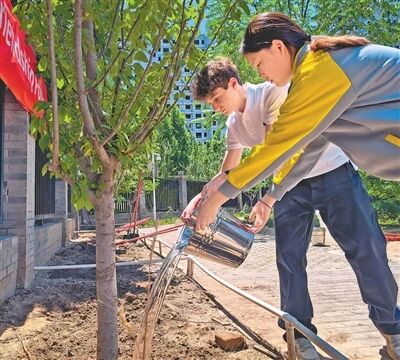
Organized by the Beijing People’s Association for Friendship with Foreign Countries, the event brought together 12 U.S. middle school students and their Chinese peers. Their day featured a rich lineup of activities, including a friendly basketball match and hands-on course experiences, and the planting of five crabapple saplings. During the basketball match, cheers erupted one after another as friendship grew amid applause and excitement. In the low-altitude aircraft class, Chinese and U.S. students learned together about the structural parameters of unmanned aerial vehicles. In the drama class, they jointly performed a short play titled “A Journey Across Mountains and Seas: Friendship Through Courtesy”.
“The children are all very excited. Some of them began learning Chinese as early as kindergarten, while some started in primary school. This visit has given them an authentic, first-hand encounter with China, turning what they learned from books into real-life impressions,” said Josh Ackerman, the teacher who led the Avenues New York delegation. “By learning to respect each other and carry forward friendship, the students have benefited greatly from this exchange.”
Fourteen-year-old Max Krane, who has been learning Chinese for 11 years, had already made several new Chinese friends after a single morning of activities. “The friendly basketball match brought us closer, and the science and technology class felt very new to me,” he told the reporter. “I have heard the story of China-U.S. ‘Ping-Pong Diplomacy’ and this event embodies similar spirit—promoting bilateral ties between the two countries through people-to-people exchanges. For middle school students like us, it’s a meaningful visit to enhance communication and mutual understanding.”
“Which subject do you find the most difficult?” “What do you do after school?” “What does your school look like?” These questions sparked lively interactions, with students from both countries eagerly raising their hands to engage in spirited dialogue and exchange gifts. “The students are very curious about each other, and they hope to develop a genuine understanding of each other by taking the initiative to learn more,” Ackerman said.
In the school’s Seasons Garden, students from the two countries filled in the soil, watered the saplings and firmed them in place, planting a China-U.S. youth friendship forest together. The newly planted crabapple saplings stretched their branches and leaves in the bright sunshine, brimming with vitality. “The young trees will grow, and our relationship will grow closer, too. Planting this forest is a gesture toward the future: it improves the environment, but just as importantly, it nurtures a lasting bond between us,” Max said.
“Young people will shape the future of U.S.-China relations. Building such a bond through tree planting is meaningful, and cooperation in green and low-carbon development will help advance the positive development of relations between the two sides,” said Jonathan Krane, Chairman of the US-China Green Institute and head of the U.S. delegation. He called for strengthening youth exchanges between the U.S. and China, and for providing them with a platform to meet and get to know one another, learn from each other, and build lasting friendships.
“Many years later, I believe these crabapple trees will remind us of this wonderful and unforgettable day,” Max said. “The small saplings will witness the growing friendships between our two schools as they flourish through cooperation.”