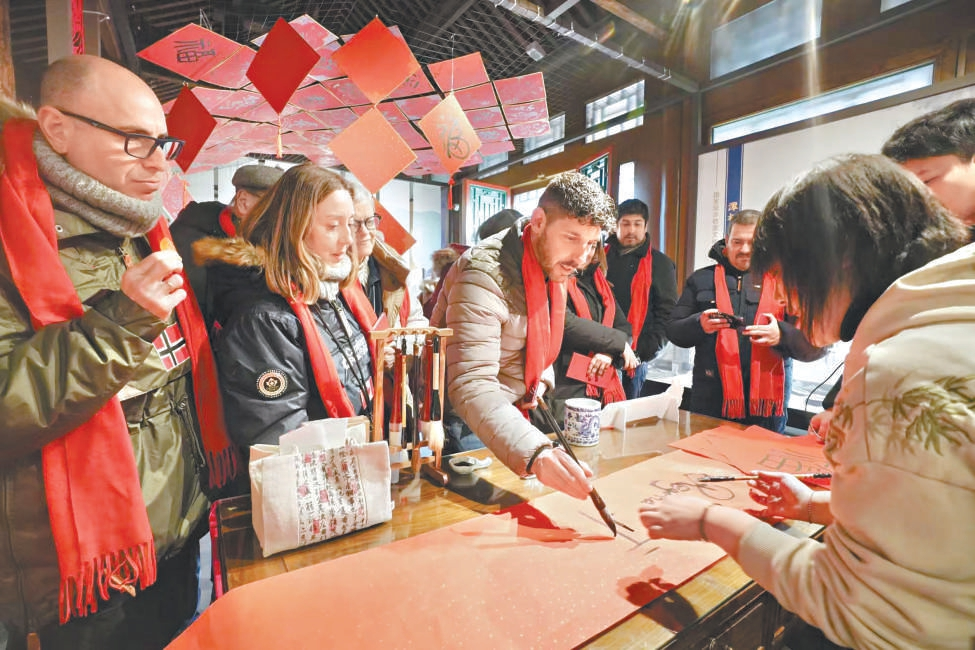
At the calligraphy experience area, foreign visitors write the Chinese character “Fu” (good fortune) and Spring Festival couplets in English, appreciating the distinctive charm of Chinese calligraphy.
Recently, the Beijing Intangible Cultural Heritage Center hosted a thematic event, “Chinese New Year with Intangible Cultural Heritage: Foreign Visitors Celebrate the Spring Festival in China” in a traditional courtyard (siheyuan). International visitors from Spain, Portugal, Brazil, and other countries were invited for an immersive experience of the distinctive appeal of the Spring Festival, a UNESCO-recognized item of the Intangible Cultural Heritage of Humanity. Through interactive activities, the event aimed to foster cultural exchange between China and the rest of the world.
The venue was decorated with festive lanterns and streamers, reflecting the lively atmosphere of the Year of the Fire Horse. Upon entering the siheyuan, foreign guests were greeted with the aroma of tea, sweets, and red scarves, embarking on an immersive journey into intangible cultural heritage for the Spring Festival. They took photos in front of a screen wall combining Tu’er Ye (Lord Rabbit), calligraphy, and the “Fu” character, experiencing firsthand the contemporary presentation of Beijing’s intangible cultural heritage. Across the four interconnected courtyards, intangible cultural heritage items and interactive activities offered visitors a comprehensive encounter with the essence of traditional Chinese culture.
Centered on intangible cultural heritage, the event offered foreign visitors immersive experiences through multiple distinctive activities, allowing them to fully enjoy traditional Spring Festival customs.
In the calligraphy experience area, participants dipped writing brushes in ink and wrote the Chinese character “Fu” and English Spring Festival couplets, appreciating the unique charm of Chinese calligraphy with every stroke. At the cloisonné enamel workshop, foreign visitors filled copper-wire patterns with enamel, experiencing the precision and craftsmanship of this national-level intangible cultural heritage firsthand. In the Shengxifu fur hat experience area, participants tried on hats from this century-old heritage brand while learning about the cultural stories behind its traditional craftsmanship.
Dian Cha, or tea-whisking, originating from the Song Dynasty, complemented the art of guqin, a traditional Chinese musical instrument. The gentle aroma of tea and the flowing melodies created an atmosphere that immersed foreign visitors in the refined aesthetics of Chinese lifestyle. At the Beijing Clay Figure Zhang experience area, participants tried to create cute painted clay horses under the guidance of an inheritor of this craft. By learning about the cultural symbolism of “Ma”, or the horse, they came to appreciate the Spring Festival blessings embodied in phrases such as “Ma Shang Ru Yi” (May everything go as you wish) and “Ma Shang Fu Lu” (May good fortune arrive at once), forging a bridge of emotional resonance across cultures.
“Goldfish-shaped dumplings symbolize abundance year after year, ingot-shaped dumplings are filled with hawthorn for a sweet-and-sour taste, and ‘Fu’-character dumplings are stuffed with shrimp and water chestnuts.” A Spring Festival experience would not be complete without the warmth of everyday culinary traditions. Guided by professional chefs, international visitors learned to make dumplings, from rolling out the dough and adding fillings to carefully pleating the wrappers. Through preparing and tasting the dumplings, they gained a better understanding of the cultural significance of reunion and harmony associated with the Spring Festival. A visitor from Mexico told reporters with a smile that forming neat dumpling pleats was somewhat challenging at first, but her skill improved with practice. This is her second visit to China. She noted that, beyond visiting well-known attractions, this time she got to engage closely with local residents. Such experiences, she said, enabled her to gain a more direct understanding of Chinese culture, and she looks forward to sharing these memorable moments with her family back in Mexico.
The Spring Festival has been inscribed on the Representative List of the Intangible Cultural Heritage of Humanity. This thematic event offered a platform for showcasing and promoting the shared celebration of the Spring Festival. Through participation, international visitors went beyond written descriptions and visual displays to experience firsthand the cultural significance and unique charm of the Spring Festival—bidding farewell to the old, welcoming the new, praying for blessings and good fortune, and celebrating reunion and harmony. In this way, the finest elements of traditional Chinese culture are shared with the world in forms that can be felt, touched, and echoed.