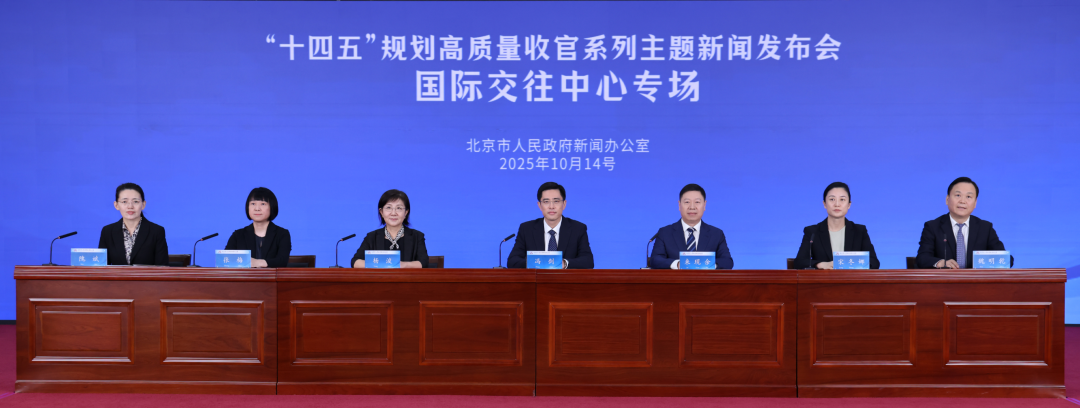
On October 14, the Information Office of Beijing Municipality held a press conference to present the city’s achievements in pursuing high-quality development during the 14th Five-Year Plan period, with a specific session on the development of Beijing’s role as the center for international exchanges. Officials from the Office of Foreign Affairs Committee of the CPC Beijing Municipal Committee and Foreign Affairs Office of the People’s Government of Beijing Municipality, the Beijing Municipal Commission of Planning and Natural Resources, the Beijing Municipal Commission of Development and Reform, the Beijing Municipal Administration of Government Services and Data Management, Chaoyang District, and Beijing North Star Company Limited provided briefings and answered questions from the press. The event was moderated by Wei Bin, Deputy Director of the International News Division of the Publicity Department of the CPC Beijing Municipal Committee.
Lai Xianyu, Deputy Director General of the Beijing Municipal Commission of Development and Reform:
The center for international exchanges is a key component of Beijing’s strategic positioning as “four centers” and a core function of the capital. During the 14th Five-Year Plan period, Beijing has seen its two airports, as key platforms for international exchanges, strengthening their roles as international aviation hubs and significant gateways. This has played a critical role in supporting China’s overall diplomatic agenda, serving Beijing’s international exchanges, promoting regional development, and facilitating resident travel. The city has successfully made the transition from a transportation hub to a gateway for international exchanges, injecting new momentum into high-standard opening up.
First, Beijing’s two airports serve as leading gateways foropening up, providing high-quality services to major state events. The city, adheringto the highest standards, has deepened collaboration with the Civil Aviation Administration of China and pooledresources to continuously optimize the developmentand operation of Beijing Capital International Airport and Beijing Daxing International Airport. By fully utilizing the two airports’ roles as the “First National Gateway” and the “New National Gateway,” Beijing successfully provided service support for over ten major home-grounddiplomatic events, state events, and cultural-sporting events, including the activities commemorating the 80th Anniversary of the Victory of the Chinese People’s War of Resistance Against Japanese Aggression and the World Anti-Fascist War, the Belt and Road Forum for International Cooperation (BRF), the Beijing Summit of the Forum on China-Africa Cooperation, and the Beijing Winter Olympics. As a result, the capital’s exemplary and leading role in international exchanges has been significantly enhanced.
Second,Beijing’s extensive air route network that covers five continents serves as important foundation for the city’s international exchanges by ensuring smooth travel of people and goods.During the 14th Five-Year Plan period, the influence of Beijing’s two airports as key nodes in the global air network has steadily increased, which helps expand the city’s international “circle of friends.” Now, Beijing has built an air route network that connects five continents and covers major cities across China, linking over 120 destinations in 64 countries and regions. The network ranks first in China in coverage and second in flight frequency, continuously enhancing Beijing’s high-standard opening up and international competitiveness. In 2024, Beijing’s two airports handled a record-breaking 117 million passenger trips, surpassing the 100 million mark for the first time in five years. This performance ranked second in China and fifth globally. The city’s ports processed 4.85 million inbound and outbound trips by foreign nationals, representing a 125% year-on-year increase; inbound trips reached 3.21 million, an increase of 188% year-on-year. Cargo and mail throughput reached 1.7695 million tons, representing a 30.11% year-on-year increase,10.91 percentage points higher than the national average.
Third,Beijing’s efforts to builditself a core hub of the Air Silk Roadserve as a strong support for its integration into the national Belt and Road Initiative (BRI). In 2024, the Opinions of the CPC Central Committee and the State Council on Optimizing Regional Opening-up Layout and Expanding High-Standard OpeningUp in the New Era by the CPC Central Committee and the State Council explicitly put forth that supports will be rendered to Beijing and other aviation hub cities to accelerate the development of the Air Silk Road, and to establish Beijing as a core of this network. Aligning with the national strategy for high-standard opening up, Beijing issued the Implementation Plan for Advancing the Air Silk Road Core Hub, actively promoting hard connectivity through infrastructure with BRI countries, soft connectivity through aligned rules and standards, and heart-to-heart connectivity through cultural exchanges. Currently, Beijing is connected with 70 BRI destinations via94 air routes ranking first among Chinese cities in both route coverage and flight frequency, providing efficient channels for passenger travel and goods transport, and consolidating Beijing’s strategic position in the Air Silk Road. Beijing also supports relevant local enterprises to actively participate in BRI aviation hub projects. These enterprises have undertaken landmark projects such as the expansion of Velana International Airport in the Maldives and the construction of the Msalato International Airport in Dodoma, Tanzania, promoting the export of Chinese construction standards, technology, aviation planning, and operational management services, and creating tens of thousands of jobs in host countries.
Fourth,Beijing, by tapping into civil aviation’s advantage of “global connectivity”,is opening its door wider forits global trade and economic activities. As a key infrastructure and link in globalization, civil aviation has unique strengths in bridging spatial and temporal distances, efficiently supporting the movements of goods and people, and deeply integrating global networks. Beijing’s two airports, as central hubs driving global technological innovation and international cooperation, have set exemplary standards in concentrating global innovation resources, developing the city as an international consumption center, and aligning with high-standard international trade rules. These efforts have attracted 271 regional headquarters of multinational companies to Beijing, over 279 foreign-funded R&D centers, and a total of 35,000 foreign enterprises. Beijing is also taking active measure to develop airport economy demonstration zones focused on specific sectors such as aviation services, international pharmaceutical logistics, and intelligent equipment. Since the implementation of the 14th Five-Year Plan, enterprises above designated size settled in the Beijing Capital International Airport Economic Zone have achieved an average annual growth of 11% in their revenue, which reached351.5 billion yuan in 2024. According to the 2024 performance assessment that covers 154 bonded zones nationwide released by the General Administration of Customs, theBeijing Daxing InternationalAirport bonded zone climbed 47 places compared with the previous year — the largest increase nationwide — and its import-export value ranked third in the country.
During the “15th Five-Year Plan” period, we will adhere to Xi Jinping Thought on Socialism with Chinese Characteristics for a New Era as our guiding principle. In line with the new stage, new circumstances, and new requirements, we will take serving Beijing’s development in the new era as the overarching objective, focus on strengthening the role of Beijing’s two internationalairports as comprehensive and multifunctional gateways, prioritize the task to build Beijing into a core hub of the Air Silk Road. By doing so, Beijing’s leading position in openness will be constantly enhanced. Through the high-quality development of Beijing’s aviation hubs, we aim to better support Beijing’s function as a center for international exchanges.
Question from the Press
Reporter:We have noticed that over the past five years, Beijinghas made remarkable and widely recognizedprogress in building up its aviation hubs. Could you briefly introduce the key development tasks for Beijing’s aviation hubs in the future?
Lai Xianyu, Deputy Director General of the Beijing Municipal Commission of Development and Reform:
During the “15th Five-Year Plan” period, we will actively coordinate with the Civil Aviation Administration, General Administration of Customs, National Immigration Administration, Capital Airports Holding Co., Ltd., and relevant airlines to advance the developmentof Beijing’s aviation hubs to ensure faster implementation of the following four key tasks:
First, we will continue to expand the capabilities of Beijing’s two airports. This involves fully implementing their role as comprehensive, multifunctional international aviation gateways, and further enhancing their connections to major global aviation hubs, key capital cities, and BRI countries. By 2030, Beijing aims to achieve a passenger throughput exceeding 160 million and a cargo and mail throughput exceeding 2.5 million tons.
Second, we will accelerate the planning and construction of major aviation hub projects. Specific efforts will be made to improve Beijing Capital International Airport’s service quality and efficiency, thusenhancing its composite strength as the “First National Gateway”. We will actively promote the early commencement of the satellite hall project at the Beijing Daxing International Airport to meet annual capacity requirements, enhance the airport’s ability to accommodate international passengers, and fully unleash it potentials as a new driving force for national development. In addition, we will continue to improve the ground transportation and logistics systems serving both airports.
Third, we will focus on optimizing internal services. Efforts will be made to continuously enhance operational service quality, further reduce flight turnaround and taxiing times, and improve on-time departure and gate assignment rates. We will also develop pilot international air-rail intermodal products. At the same time, we will continuously improve international transfer efficiency, further streamlinecustoms clearance procedures, increase port efficiency, and improve connectivity between different transportation modes.
Fourth, we will vigorously promote the deep integration of aviation and urban development. This includes optimizing the “aviation+commercial district” development model to build a consumer hub around airports, continuously enhancing inbound tourism service mechanisms, planning and organizing events related to the Air Silk Road initiative, and supporting enterprises’ participation in airport commercial operations to foster a sustainable airport service and business ecosystem. We will also focus on cultivating new growth drivers for the airport economy by building a world-class aviation headquarters base and an Asia-Pacific leading aircraft maintenance base, strengthening the airport-centered national logistics hub function, consolidating and expanding the cross-border pharmaceutical and health industry cluster, building a civil aviation science, education, and innovation base, and continuously growing the intelligent manufacturing industrial cluster in airport-adjacent areas.